AI Short Video Production · Deepege Editorial Team
Corporate Video Examples: 7 Videos by Type and What to Borrow
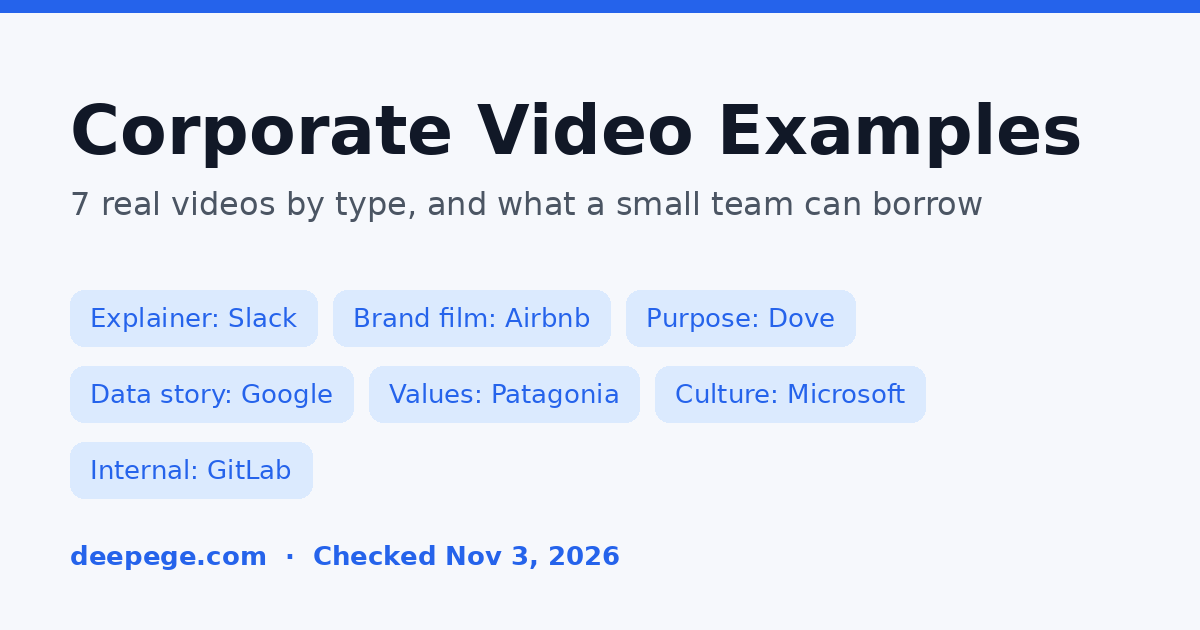
The best corporate video examples each do one job well: Slack's "So Yeah, We Tried Slack …" explains a product, Airbnb's "Made Possible by Hosts" tells a brand story with customers' own photos, Dove's "Real Beauty Sketches" turns a purpose into an experiment, and GitLab's public Unfiltered channel shows what internal communications video looks like when it is shared openly. Below are 7 corporate video examples we opened on each company's own site or channel on November 3, 2026, grouped by the job they do and what a small team can borrow.
Key points:
- A corporate video is any video a company makes about itself rather than a single product ad: explainers, brand films, culture and recruiting videos, customer stories, data stories and internal updates.
- Pick the example that matches your goal first. A recruiting video and a product explainer need different people on screen, different lengths and different places to live.
- Most of the examples below are cheap to imitate in structure: one clear message, real people or real material, and captions.
- Internal communications videos are the least visible type online. GitLab is a rare company that publishes team meetings, release kick-offs and CEO sessions on a public YouTube channel.
- Before you publish, check each platform's limits. On November 3, 2026, LinkedIn's help page allowed videos up to 15 minutes and YouTube's help page allowed Shorts up to 3 minutes.
What is a corporate video?
A corporate video is a video produced by a company to explain who it is, what it does, how it works or what it stands for, aimed at customers, candidates, investors or its own employees. It differs from a product ad because the subject is the company, its people or its point of view, not one offer.
The common types are:
- Explainer: how the product or service works, usually 1 to 3 minutes.
- Brand film: a story about the company's role in people's lives.
- Purpose or values film: a campaign built around something the company believes.
- Data story: the company turns its own data into a narrative.
- Customer story: real customers tell what changed for them.
- Culture and thought leadership: employees explain how they work.
- Internal communications: leadership updates, all-hands recaps, onboarding and policy changes.

7 corporate video examples by type
These 7 corporate video examples cover the main types. Each one links to the company's own page or official channel.
| Example | Company | Type | What to borrow |
|---|---|---|---|
| "So Yeah, We Tried Slack …" | Slack | Explainer | Show the product through a team's day, not a feature list |
| Made Possible by Hosts | Airbnb | Brand film | Build the film from customers' real photos |
| Real Beauty Sketches | Dove | Purpose film | Turn a belief into a simple experiment people can watch |
| 2025 Year in Search | Data story | Let your own data carry the story | |
| Worn Wear | Patagonia | Values documentary | Film customers and the products they kept |
| Microsoft as Customer Zero | Microsoft Research | Culture and thought leadership | Let employees explain how they use your own product |
| GitLab Unfiltered | GitLab | Internal communications | Record meetings and publish what is safe to share |
1. Slack: "So Yeah, We Tried Slack …" (explainer)
Slack's explainer shows a team describing, documentary-style, how its workday changed after it started using Slack, instead of walking through features one by one.
- Link: Slack on YouTube
- Format: published on Slack's official channel on August 12, 2014; about 2 minutes 21 seconds.
- Why it works: the product appears inside a believable team routine, so viewers see the problem and the fix at the same time.
- Borrow it: write your explainer as "a week in the life of a customer team" and cut every feature that doesn't appear in that week. Our SaaS explainer video guide has a 5-part script for this.
2. Airbnb: Made Possible by Hosts (brand film)
Airbnb's Made Possible by Hosts campaign is a series of short films made from real photographs taken by guests during stays with Airbnb hosts.
- Link: Airbnb Newsroom post
- Format: launched February 22, 2021 as a series; the newsroom post introduces four films, including "Forever Young" and "Sweet Child O' Mine".
- Why it works: Airbnb says the aim was to show the experiences hosts make possible, and using guests' own photos makes the story feel lived rather than staged.
- Borrow it: ask customers for photos or clips they already have (with written permission) and build a 30 to 60 second story around them.
3. Dove: Real Beauty Sketches (purpose film)
Dove's Real Beauty Sketches film records an experiment: a forensic artist draws women from their own description and again from a stranger's description, and the women compare the two portraits.
- Link: Dove campaign page
- Format: a film of the women's reactions to the two portraits. Dove's page says more than 50 million people viewed it within 12 days and that it has been viewed almost 180 million times.
- Why it works: the brand's belief is proven on screen by the experiment, not stated in a voiceover.
- Borrow it: design one simple test that demonstrates what your company believes, and film the reactions honestly.
4. Google: 2025 Year in Search (data story)
Google's Year in Search film is an annual video built from the year's search trends, published alongside a Year in Search website.
- Link: Google on YouTube and the Google blog post from December 4, 2025
- Format: a montage of the year's moments, published with a blog post on December 4, 2025 that adds data points, such as queries starting with "How do I…" reaching an all-time high.
- Why it works: only Google has this data, so the video can't be copied by a competitor.
- Borrow it: turn your own numbers (support tickets, orders, most-asked questions) into a yearly "what our customers did" video.
5. Patagonia: Worn Wear (values documentary)
Patagonia's Worn Wear is a documentary about the stories behind clothes people keep wearing, published on Patagonia's official YouTube channel as "Worn Wear: a Film About the Stories We Wear".
- Link: Patagonia on YouTube
- Format: documentary on Patagonia's official channel. Patagonia's own story page about the film was down for maintenance when we checked, so we describe it only from the official video listing.
- Why it works: the subject is the owners and their stories, so the product earns attention without a sales pitch.
- Borrow it: interview long-time customers about one product they still use, and let the wear on the product do the selling.
6. Microsoft Research: Microsoft as Customer Zero (culture and thought leadership)
Microsoft Research's "Microsoft as Customer Zero: Empowering Research Teams with AI" features four Microsoft Research speakers explaining how they use AI in their own research work.
- Link: Microsoft Research video page
- Format: published on the Microsoft Research YouTube channel on April 30, 2025; about 3 minutes 15 seconds; named speakers with titles.
- Why it works: employees describe how they use their own company's tools, which works as both thought leadership and a culture video for candidates.
- Borrow it: interview two or three team members about how they actually work, and name them on screen.
7. GitLab: GitLab Unfiltered (internal communications)
GitLab Unfiltered is GitLab's public YouTube channel for team and community content, including team meetings, monthly release kick-offs, office hours and CEO 101 meetings, according to the GitLab Handbook.
- Link: GitLab Handbook: YouTube uses and access
- Format: recorded meetings and livestreams; the handbook asks team members to record meetings so people in other time zones can catch up asynchronously.
- Why it works: it shows internal communication as it really happens, and recording by default makes every meeting reusable.
- Borrow it: record your next all-hands, then cut a 2 to 3 minute recap for the people who missed it. Keep confidential topics out of anything shared outside the company.
What are good internal communications video examples?
Good internal communications videos are short, specific and easy to replay: a leadership update after a decision, an all-hands recap, a policy or process change, a new-hire welcome and step-by-step training. Few companies publish them, which is why GitLab Unfiltered stands out as a public example.
| Internal video | Who should appear | When to make it | Keep it |
|---|---|---|---|
| Leadership update | CEO or the decision owner | Within a day of a big decision | One decision, the reason, what changes for staff |
| All-hands recap | Host of the meeting | Right after the meeting | Main points with links to the full recording |
| Policy or process change | The team that owns the process | Before the change takes effect | What changes, from when, where to ask |
| New-hire welcome | Manager and a peer | Before day one | Who's who, first-week schedule |
| Training or how-to | A subject expert | Whenever the process is updated | One task per video, screen recording plus voice |
Training and policy videos go out of date fastest. Teams that update them often sometimes use an AI avatar or AI voiceover so they can change the script without re-filming; if you do, tell viewers the presenter is AI-generated. Our eLearning video production guide covers training video in more detail.
How do you make a corporate video on a small budget?
You make a corporate video on a small budget by choosing one goal, using real people or material you already have, and planning cut-down versions for each platform before you film.
- Pick one goal and one audience. "Explain onboarding to new customers" is a goal; "show who we are" is not.
- Choose the type from the examples above. Match the type to the goal, not to what looks impressive.
- Write a script with one message. Draft it scene by scene with the AI video script generator, then cut anything that doesn't support the message.
- Decide who is on screen. Employees for culture and internal videos, customers for stories, a presenter or narrator for explainers. A narration track can come from the AI voiceover generator.
- Add captions. The W3C's guidance on captions and subtitles explains that captions are needed by people who are Deaf or hard of hearing, and they also help people watching with the sound off.
- Cut versions per platform. On November 3, 2026, LinkedIn allowed videos up to 15 minutes, and YouTube's help page listed Shorts as up to 3 minutes with a square or vertical aspect ratio.
- Set a review date. Internal and training videos need a check whenever the process changes.
For a cost breakdown of agency, in-house and AI options, see our video production cost guide.

Deepege: our product, for recurring marketing video
Deepege is our own product, so weigh this section accordingly. It suits teams that publish short marketing videos regularly to several platforms, not one-off brand films or live internal meetings.
On deepege.com, the agent writes the script and a director's plan shot by shot, uses your own footage first and fills gaps with public assets, AI shots or digital avatars, then waits for your approval. Voice, subtitles, text overlays and cover are finished together, and videos publish to Douyin, Kuaishou, WeChat Channels, Xiaohongshu and TikTok accounts. The pricing page asks for a fit assessment and says Deepege is not a fit if you publish on just one platform or have no ongoing content schedule.
How we chose these examples
We opened every example on November 3, 2026 on the company's own website or its official YouTube channel, and confirmed each YouTube video's channel through YouTube's public oEmbed data. For Airbnb and Dove, the copies that rank highly on YouTube were uploaded by third-party channels, so we link to the companies' own pages instead. Dates, lengths and view figures come only from those official pages; Dove's view counts are Dove's own claims.
We picked examples to cover different types, not to rank them. We didn't include examples we could only find through third-party roundups, and we didn't measure results such as sales or hires, which the companies don't publish for most of these videos.
Conclusion
The corporate video examples worth copying share three habits: one clear job, real people or real material, and a format the company can repeat. Start with the type that fits your goal, borrow its structure, and plan captions and platform versions before you film.
FAQ
What are examples of corporate videos?
Examples of corporate videos include Slack's "So Yeah, We Tried Slack …" explainer, Airbnb's Made Possible by Hosts brand films, Dove's Real Beauty Sketches, Google's Year in Search, Patagonia's Worn Wear, Microsoft Research's Customer Zero video and GitLab's Unfiltered meeting recordings.
What are the main types of corporate video?
The main types are explainers, brand films, purpose or values films, data stories, customer or community stories, culture and thought leadership videos, and internal communications videos such as leadership updates and training.
What is an internal communications video?
An internal communications video is a video made for a company's own employees, such as a leadership update, an all-hands recap, a policy change, a new-hire welcome or a training video. GitLab publishes many of its non-confidential team meetings on its public GitLab Unfiltered channel.
How long should a corporate video be?
There is no single right length. The explainer and culture examples in this guide run about 2 to 3 minutes, and platform limits also matter: on November 3, 2026, LinkedIn allowed up to 15 minutes and YouTube Shorts up to 3 minutes.
How can I make a corporate video cheaply?
Choose one goal, use people and material you already have, write a one-message script, add captions and cut versions for each platform before you film. AI script, voiceover or avatar tools can help with training and update videos that change often.